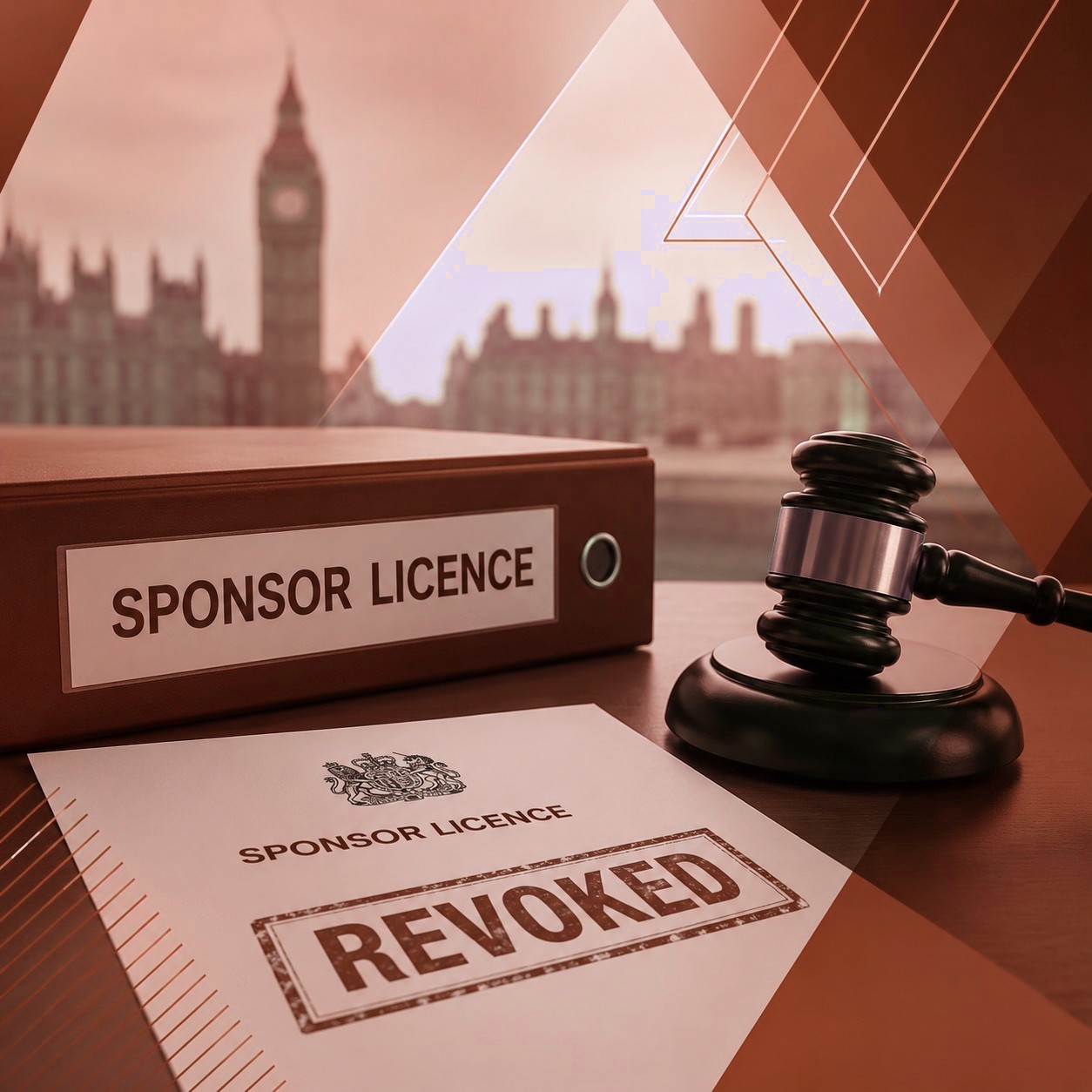
SPONSOR LICENCE SUSPENDED, DOWNGRADED, OR REVOKED?
Act Fast – Every Day Counts.
Whether you’ve received a compliance visit notice, a suspension letter, a B-rating action plan, or a revocation decision, we act immediately to protect your licence and your workers.
24 days – Fastest reinstatement secured for a client after revocation. Read more
If you want to get ahead of a compliance issue before it happens, see our compliance audit service.
ON THIS PAGE
RECEIVED NOTICE OF A HOME OFFICE COMPLIANCE VISIT?
A Home Office compliance visit – sometimes called a UKVI compliance audit – can be announced or unannounced. Officers will typically review:
- HR systems and record-keeping – Personnel files, contracts, job descriptions, and evidence that sponsored workers are doing the jobs described on their Certificates of Sponsorship.
- Right-to-work records – Document checks, copy retention, and follow-up checks for time-limited permission holders.
- Genuineness of roles – Whether the roles you’re sponsoring actually exist, match the stated occupation codes, and meet the required skill and salary thresholds.
- SMS compliance – Your Sponsorship Management System usage, reporting history, and whether changes have been reported within required timeframes.
What to do in the 24-48 hours before a visit
If you’ve received advance notice, the window before a visit is critical. An immigration solicitor for employers can help you audit your own records, identify gaps before the Home Office does, and – where appropriate – attend the visit with you to ensure your business is properly represented.
Even if the visit is unannounced, instructing a specialist immediately after the officers leave can help you respond to any concerns raised before they escalate to suspension or revocation.
SPONSOR LICENCE SUSPENDED – WHAT IT MEANS AND WHAT HAPPENS NEXT
A suspension is not the same as a revocation – it is provisional, not final. However, it has immediate practical consequences:
- No new Certificates of Sponsorship – You cannot assign any new CoS while suspended, meaning you cannot recruit or onboard new sponsored workers.
- Existing workers are not immediately affected – Sponsored employees already in the UK can continue working during the suspension period.
- The Home Office will decide next steps – After reviewing representations, they will either lift the suspension and restore your A-rating, downgrade you to a B-rating with an action plan, or proceed to revocation.
This is the moment representations matter most. The decision has not yet hardened into a revocation. Detailed, evidence-backed representations submitted during the suspension window are the most effective way to protect your licence – and the point at which legal input has the greatest impact.
We prepare and submit representations on your behalf, addressing the specific concerns raised by the Home Office and presenting the evidence needed to secure the best possible outcome.
DOWNGRADED TO A B-RATING? YOUR ACTION PLAN DEADLINE MATTERS
A B-rating means the Home Office has identified compliance failings serious enough to downgrade your licence, but not so serious as to warrant immediate revocation. You will be given an action plan – typically with a 3-month deadline – to demonstrate that the issues have been resolved.
What the action plan requires
The specifics vary by case, but common requirements include:
- Updating HR and record-keeping systems to meet Home Office standards
- Conducting and documenting retrospective right-to-work checks
- Filing overdue reports on the Sponsorship Management System
- Providing evidence that sponsored workers’ roles, salaries, and working conditions match their Certificates of Sponsorship
What happens if you miss the deadline
If you fail to satisfy the action plan within the specified period, the Home Office will revoke your licence. There is no extension – the deadline is final. This is one of the discretionary grounds for revocation, but in practice, a missed action plan deadline almost always leads to revocation.
A lawyer can help you build a compliant action plan response, ensure the evidence is presented in the format the Home Office expects, and avoid the common mistakes that lead sponsors to fail the process despite having resolved the underlying issues.
WHY SPONSOR LICENCES GET REVOKED
Based on official Home Office sponsor guidance, the following are the most common grounds for suspending or revoking a Worker/Temporary Worker sponsor licence.
Mandatory grounds (Home Office will revoke)
- False or Misleading Information – Knowingly providing false information in a licence application, or in a Certificate of Sponsorship (CoS) – including about skill level, salary, or job requirements.
- Loss of UK Trading Presence – The business is sold, becomes insolvent, goes into liquidation, is struck off the Companies House register, or otherwise stops trading in the UK.
- Loss of Required Registration or Licence – Where a business must be registered with, inspected by, or licensed by a regulatory body to trade legally (e.g. CQC, professional regulators) and stops being so registered or licensed.
- Underpaying a Sponsored Worker – Paying a sponsored worker less than stated on their CoS, without properly notifying the Home Office or having a permitted reason for the reduction.
- Illegal Working / Civil Penalties – Failing right-to-work checks, employing illegal workers, or being issued civil penalties that remain unpaid once appeal rights are exhausted.
- Non-Genuine or Mismatched Roles – Assigning a CoS for a role that doesn’t exist, is exaggerated, or doesn’t match the actual job the worker performs (occupation code or job description).
Discretionary grounds (Home Office may revoke)
- Reporting Duty Failures – Failing to report changes such as a worker’s absence, resignation, change of role, or changes to the business (ownership, structure, address) within required timeframes.
- Failed Action Plan (B-Rating) – After being downgraded to a B-rating for a minor breach, failing to meet the requirements of the resulting action plan within the specified period (usually 3 months).
- Misuse of Certificates of Sponsorship – An SMS user assigning a CoS to themselves or a close relative, or assigning CoS while B-rated to workers not previously sponsored.
Source: Workers and Temporary Workers: guidance for sponsors, Part 3 – sponsor duties and compliance (GOV.UK), Annexes C1-C3.
THE CONSEQUENCES OF REVOCATION
Per GOV.UK guidance, revocation is one of the most severe actions the Home Office can take against a sponsor – and the effects are immediate.
- No right of appeal – Revocation decisions cannot be appealed – the only route is a legal challenge (e.g. judicial review) or a fresh application after the cooling-off period.
- Minimum 12-month cooling-off – You cannot reapply for a licence for at least 12 months (24 months if revoked more than once) from the date of the decision letter.
- All CoS become invalid – Every Certificate of Sponsorship you’ve assigned is automatically invalidated – pending visa applications based on them will be refused.
- Sponsored workers’ visas curtailed – Workers’ permission is typically cut to 60 days (or less), forcing them to find a new sponsor or leave the UK.
- Removal from the public register – Your organisation is removed from the Register of Licensed Sponsors, visible to clients, partners, and regulators.
- Immediate loss of sponsorship rights – You cannot assign any further CoS in any route while the revocation stands.
Source: Employees: if your visa sponsor loses their licence (GOV.UK) and Part 3 sponsor guidance, sections C9-C10.
CAN YOU APPEAL A SPONSOR LICENCE DECISION?
The short answer depends on where you are in the process:
1. At suspension or action-plan stage: you can make representations
Before a final decision is made, the Home Office invites representations. This is the real leverage point – a well-prepared submission addressing their specific concerns, supported by documentary evidence, can lead to a suspension being lifted or a B-rating being restored to an A-rating. This is where specialist legal input has the greatest practical impact.
2. Once revoked: there is no right of appeal
There is no formal appeal mechanism against a sponsor licence revocation. The only routes available are:
- Judicial review – Challenging the lawfulness of the decision in the High Court, on grounds such as procedural unfairness, failure to consider relevant evidence, or irrationality.
- Fresh application – Reapplying for a new licence after the cooling-off period (minimum 12 months, or 24 months if revoked more than once).
3. We help at every stage
Whether you need representations drafted during a suspension, an action plan response built to meet Home Office standards, or advice on challenging a revocation through judicial review, we act at whichever point you come to us – and the earlier, the better.
ILLEGAL WORKING PENALTIES AND RIGHT TO WORK AUDITS
A civil penalty for illegal working doesn’t just mean a fine – it can directly trigger a sponsor licence suspension or revocation, particularly if the penalty remains unpaid once appeal rights are exhausted.
How civil penalties connect to your sponsor licence
- A civil penalty notice is issued when the Home Office determines you employed someone without the right to work, or failed to conduct proper right-to-work checks.
- Under the mandatory grounds for revocation, unpaid civil penalties (once appeal rights are exhausted) will result in your licence being revoked.
- Even where a penalty is paid, the underlying right-to-work failures may separately trigger a compliance visit, suspension, or B-rating downgrade.
For detailed information on current civil penalty amounts, the right-to-work checking process, and how to prepare for a compliance audit, see our UK Immigration Compliance Audits page.
If you have already received a civil penalty notice or are responding to a right-to-work audit, contact us immediately – the response window is limited, and the consequences for your sponsor licence depend on how quickly and effectively you act.
CASE STUDIES: LICENCES WE’VE FOUGHT FOR
Real outcomes from clients we’ve represented – including cases where reinstatement is generally considered against standard Home Office practice.
Dental Practice: Sponsor Licence Revoked Over Alleged “Underpayment” – Revocation Withdrawn in 24 Days
A thriving UK dental practice group serving over 70,000 patients had its sponsor licence revoked with immediate effect after the Home Office concluded that sponsored workers were being underpaid – triggering a mandatory revocation ground.
The reality was more complex. The practice had moved staff from PAYE to self-employed arrangements without fully updating its sponsorship records or reporting the changes through the Sponsor Management System. When the Home Office requested payroll evidence, key documents such as P60s simply did not exist under the new structure – creating the appearance of non-payment.
We were instructed just two days after the notice was issued. We identified that, despite clear compliance failings, there was no evidence of worker exploitation or systematic underpayment – two of the three workers in question had actually been paid above their CoS salaries. On the same day as the revocation decision, we submitted an urgent Pre-Action Protocol Letter for Judicial Review, challenging factual errors in the Home Office’s findings and highlighting the potential disruption to NHS-commissioned dental services.
The Home Office withdrew the revocation within 24 days. The licence was reinstated, and the business continued operating without proceedings ever being issued.
Pharmacy: What Not to Do When Applying for a Sponsor Licence
Not every lesson comes from a courtroom win. This pharmacy client engaged legal support for a Sponsor Licence application, but progress stalled repeatedly on the employer’s side – documents were delayed, and their accountant was consistently unresponsive to information requests needed to complete the application.
Instructing a lawyer doesn’t remove the need for a business – and its accountant – to respond quickly and fully. Delays on the client’s side can undo even the strongest legal strategy, and in immigration compliance, missed deadlines have real consequences.
Speed and cooperation matter as much as legal strategy.
Laboratory: Reinstated Despite a Companies House Strike-Off
This client’s licence was revoked after their company was struck off the Companies House register – normally treated by the Home Office as loss of a genuine UK trading presence, a mandatory ground for revocation. However, this didn’t reflect the reality of the business’s continued lawful operation, and specific regulatory provisions covering this type of licensed activity meant the standard Home Office approach did not properly apply to this case.
We argued the revocation was unjustified on this basis. Although reinstatement in circumstances like this runs against typical Home Office practice, we secured it – because the underlying decision was wrong.
Licence reinstated.
SPECIALIST SUPPORT WHEN IT MATTERS MOST
- Rapid Response – Specialist immigration solicitors for employers – acting the moment a compliance issue arises, whether it’s a visit notice, suspension letter, or revocation decision.
- Sector Expertise – Experience across healthcare, dental, pharmacy, laboratory, and other regulated sponsor sectors.
- Challenging the Home Office – We know when a sponsor licence decision is wrong – and how to prove it, even in cases others walk away from.
- Protecting Your Workforce – We work to protect both your licence and your sponsored employees’ immigration status.
HOW MUCH DOES IT COST?
There’s no fixed fee for sponsor licence compliance and reinstatement work – every case depends on its complexity, from the grounds cited by the Home Office to how much evidence needs to be gathered and how quickly action is needed. Rather than quote a generic price, we offer a free assessment call to review the specifics of your case and give you a clear, tailored cost estimate before you commit to anything.
UK IMMIGRATION COMPLIANCE AUDITS
Proactive compliance audits to protect your sponsor licence before issues arise.
WHAT IS AN IMMIGRATION COMPLIANCE AUDIT?
A UK immigration compliance audit is a proactive assessment of your organisation’s ability to meet Home Office requirements.
It ensures that your HR systems, processes, and sponsorship practices comply with the law, reducing your risk of financial penalties, licence suspension, or criminal prosecution.
Failing to comply can result in:
- £45,000 per illegal worker on a first breach
- £60,000 on a repeat breach within the previous three years
- Criminal prosecution (up to 5 years in prison)
- Sponsor licence suspension or revocation
If you allow a sponsored worker to overstay their visa, missreport duties, or fail to monitor staff correctly, your organisation may lose the ability to hire non-UK workers.
OUR IMMIGRATION COMPLIANCE AUDIT SERVICES
At Cromwell Wilkes, we help businesses identify gaps in their immigration systems before the Home Office does. Our audit services include:
- Free initial consultation – by phone or in our London office
- On-site meetings with your compliance or HR team
- Detailed review of your sponsorship systems and procedures
- Mock audits simulating a Home Office visit
- Audit reports with actionable recommendations for improvement
We tailor our compliance audits to suit your business size, sponsor licence type, and sector.
WHEN SHOULD YOU GET A COMPLIANCE AUDIT?
WHEN SHOULD
YOU GET A
COMPLIANCE AUDIT?
We recommend conducting regular immigration compliance audits and training from the moment your sponsor licence is approved. Early planning helps prevent serious breaches and strengthens your sponsor licence rating.
Audits are particularly advisable if:
- You’re applying for your first sponsor licence
- You’re preparing for a Home Office compliance visit
- Your licence has been downgraded or suspended
- You’ve had staff or process changes in HR or compliance teams
- You’re renewing your sponsor licence
- You haven’t reviewed your immigration procedures in over 12 months
Being proactive protects your ability to hire global talent and shields you from reputational and legal risks.
PENALTIES FOR NON-COMPLIANCE
PENALTIES FOR
NON-COMPLIANCE
Under the Asylum and Immigration Act 1996, UK employers who breach immigration laws may face:
- £45,000 per illegal worker on a first breach
- £60,000 on a repeat breach within the previous three years
- Up to 5 years’ imprisonment for knowingly employing illegal workers
- Loss of the sponsor licence, preventing any future international hires
Already facing a compliance crisis? If your sponsor licence has been suspended, downgraded, or revoked, see our Sponsor Licence Compliance Crisis Hub for specialist help.
FREQUENTLY ASKED QUESTIONS
Information on sponsor licence compliance sourced from GOV.UK official sponsor guidance. This page is for general information only and does not constitute legal advice.