Revoked Sponsor Licence Reinstated After Company Strike-Off – Key Lessons for Sponsors
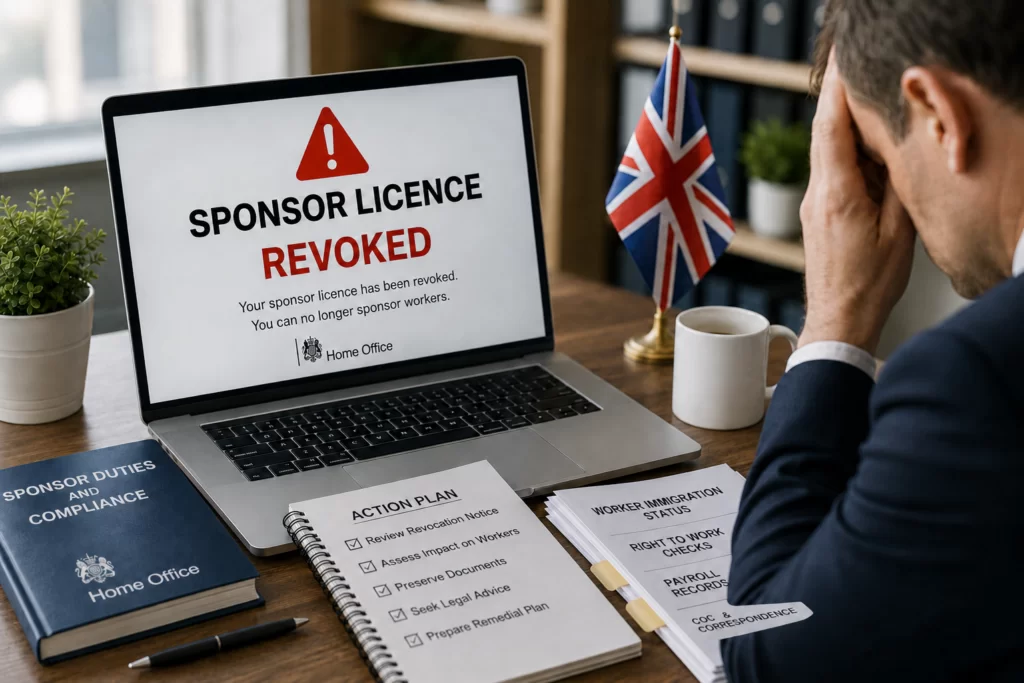
A Sponsor Licence can be critical for a business that wishes to operate, recruit and grow in the UK. For overseas businesses establishing a UK corporate presence, compliance with both company law and immigration law is essential. Even a seemingly routine corporate compliance failure can trigger significant immigration consequences – including Sponsor Licence revocation.
In this article
This case study tells the real-life story of our client (a UK subsidiary operating under the UK Expansion Worker route) who went from pursuing ambitious UK expansion plans to being struck off the Companies House register – and subsequently having its Sponsor Licence revoked by the Home Office.
We were instructed to urgently challenge the revocation and successfully secured reinstatement of the Sponsor Licence, after facing several challenges along the way.
What made this case unusual was that it depended upon the legal effect of restoring a company after it had been dissolved, which turned on a technical company law issue rather than a general immigration law issue.
This case shows how company law issues can impact Sponsor Licences, and why complex Sponsor Licence challenges require specialist legal expertise from knowledgeable lawyers.
Having successfully assisted the business in this unique case, we draw upon the key learnings and share our practical lessons for Sponsor Licence holders seeking to protect their business, workers and compliance standing.
How the Company’s Problems Started and Grew
The story begins with a UK business (operating within the pharmaceutical industry) which was a subsidiary of an overseas group, incorporated to develop operations in the UK.
The business held a Sponsor Licence under the UK Expansion Worker route, with its sponsored worker also acting as its sole director.
The UK Expansion Worker route allows overseas businesses that have not yet begun trading in the UK to send senior managers or specialist workers to establish a UK presence.
To qualify for a Sponsor Licence under this route, the overseas business must show (among other requirements):
- a UK footprint
- an overseas trading presence
- credible plans to establish a UK trading presence
Further, a UK Expansion Worker sponsor must normally establish a UK trading presence within two years of the date its licence was granted and apply to add at least one other route to its licence. If not, the Home Office may take action – including revocation.
Whilst there was genuine commercial activity within the wider overseas group in this case, the UK company itself did not develop operations as originally planned. Inactivity in the UK was a risk for the company’s licence status.
A few months before its eventual strike-off, concerns around its progress had already come to light.
The company’s confirmation statement (a key mandatory corporate governance document) was overdue and its progress in establishing its UK operation were limited.
A corrective action plan was agreed following our legal advice, which included:
- Bringing the company’s Companies House filings up to date
- Appointing an accountant
- Implementing appropriate governance structures
The objective was to rectify the company’s corporate compliance position and demonstrate progress towards establishing and managing the UK operation.
However, the company’s confirmation statement remained outstanding and unfortunately, the company was eventually struck off the Companies House register and dissolved.
How Did the Strike-Off Lead to a Sponsor Licence Revocation?
When the dissolution came to our attention, we urgently advised our client on the risks to its Sponsor Licence and immigration position.
The client was committed to its UK expansion plans and wanted to restore the company to the register and, as such, serious action became necessary on our side.
We first explored whether Companies House could reverse the strike-off without a formal restoration application.
When that was not possible, a specialist accountant was instructed by us to prepare an application for administrative restoration i.e. to restore the company to the Companies House register.
We made it clear to the client that the matter was critical. The company needed to be restored to the register as quickly as possible. If the Home Office became aware of the dissolution before restoration, the Sponsor Licence would almost certainly be revoked.
As part of the restoration strategy, we helped identify evidence supporting the position that the company had remained ‘in operation’ before it was struck off – even though substantive UK trading activity had not commenced.
Unfortunately, however (before the restoration was completed) the risk we had identified materialised. The Home Office identified the company’s dissolved status and revoked its Sponsor Licence.
The Home Office relied on one specified reason. As Companies House records showed the company had been dissolved, the Home Office concluded that it no longer had a trading or operating presence in the UK, which is a mandatory requirement for holding a Sponsor Licence.
This revocation had severe ramifications. It disrupted the company’s UK expansion plans and affected the sponsored director’s immigration position. It also had consequences for family members whose immigration status was tied to the sponsored worker’s visa.
As such, we needed to act fast and work hard to challenge the licence revocation.
Notably in this case, the client’s company was part of a wider, large business – which demonstrates that even companies related to well-established organisations can still face severe Sponsor Licence consequences if UK-level compliance breaks down.
How We Challenged the Sponsor Licence Revocation
Soon after the Sponsor Licence was revoked, the company was successfully restored to the Companies House register – with its accountant handling the restoration process and bringing the outstanding filings up to date.
However, restoring the company itself did not automatically reinstate the Sponsor Licence. We then had to challenge the Home Office to reinstate the licence.
The company’s restoration provided our key legal argument. Under the Companies Act 2006, a company that is administratively restored is deemed as having continued in existence as if it had not been dissolved. This is a powerful legal principle with retrospective effect.
This was crucial, as the Home Office had revoked the Sponsor Licence due to the company’s dissolved status. Once the company was restored, we argued that the very factual basis for this revocation had been retrospectively removed.
Importantly, the Home Office’s revocation letter stated that where a licence had been revoked in error, the usual cooling-off period would not apply, and the Home Office would arrange reinstatement.
Following the company’s restoration, we challenged the decision in strategic stages:
- We submitted formal representations seeking reinstatement of the Sponsor Licence, restoration of access to the Sponsor Management System and confirmation that the cooling-off period would not apply.
- When we did not receive a substantive response, we sent a formal follow-up letter and set a clear deadline for a response.
- When the matter remained unresolved, we sent a Pre-Action Protocol Letter before claim for Judicial Review.
Throughout the process, we worked diligently and kept our challenge focused on the specific reason the Home Office had given for revoking the licence. We also attempted quicker and more cost-effective resolution before escalating to formal legal action.
Following receipt of the Pre-Action Protocol Letter, we were delighted when the Home Office ultimately agreed and reinstated the Sponsor Licence in full.
The company did not need to submit a fresh Sponsor Licence application, the cooling-off period did not apply, and we did not need to issue Judicial Review proceedings.
This was a significant win and a remarkable outcome for the client. The case in its entirety took only 9 to 10 months to complete (from the point of instruction until licence reinstatement) showing that with the right legal strategy and persistence, even a complex revocation can be successfully reversed.
What Makes This Sponsor Licence Challenge Case So Unique?
This was an unusual case involving a range of complex company law, Sponsor Licence compliance and immigration issues.
The Home Office revoked the licence because the company had been dissolved. However, once the company was administratively restored, the law treated it as though it had never been dissolved.
Our challenge rested upon the specific reason given by the Home Office and the effect of administrative restoration under section 1028(1) of the Companies Act 2006.
Administrative restoration does not automatically reinstate a Sponsor Licence or remedy other issues arising during dissolution. In this case, however, it undermined the sole basis for the revocation.
What Can Sponsors Learn from This Case?
Though the facts of this case were of course niche and the outcome turned on a specific legal argument, it nonetheless offers important practical lessons for Sponsor Licence holders.
In particular – it interestingly highlights how corporate law compliance, immigration issues and business operational matters can connect and why sponsors should act quickly and strategically when compliance issues arise.
Key lessons to take away from this case include:
The Importance of Taking Good Legal Advice
A key message is the importance of obtaining timely legal advice from experienced advisers and then also following that advice carefully.
Sponsor Licence revocation cases can involve complex issues extending beyond immigration law points alone.
In some cases, a successful outcome can heavily depend upon the legal representative’s expertise in broader areas of law and a close coordination between professional advisers.
Here, the result turned on a highly technical point of company law – emphasising the value of seeking prompt advice from advisers with the right experience and knowledge to identify the correct legal arguments and achieve an effective resolution.
Instructing a strong legal advisor from the outset, such as on a retainer basis, can also help prevent problems like this from arising in the first place.
Routine Company Law Compliance Can Create Immigration Risk
An overdue Companies House filing may seem like a routine corporate governance issue, but where it affects a sponsor’s legal status, it can also put a Sponsor Licence at risk.
Sponsors should therefore give priority to company law compliance and Sponsor Licence compliance, making sure that all relevant obligations are met.
This case demonstrates how a routine corporate compliance failure can escalate into strike off and ultimately lead to licence revocation.
Businesses should also not just assume that their accountant is monitoring their Companies House record, unless responsibility for doing so has been clearly agreed. Responsibility for corporate and Sponsor Licence compliance ultimately lies with the business itself.
The lesson here is particularly relevant for overseas businesses establishing a UK presence. Even where a UK entity is newly established, it must still comply with Sponsor Licence duties and all applicable UK corporate obligations from the outset.
Company law compliance is itself becoming increasingly important. The Economic Crime and Corporate Transparency Act 2023 has strengthened Companies House powers, penalties and raised the stakes in respect of corporate filing failures.
In relation to Sponsor Licences, sponsors should ensure their Authorising Officer understand their responsibilities and maintain appropriate oversight over compliance duties.
Acting Fast If the Company’s Status Changes
If a sponsor company is struck off, dissolved or undergoes another significant corporate change, it should urgently review the immigration implications and seek legal advice. Depending on the circumstances, prompt action may help preserve a sponsor’s position or mitigate the damage.
Prompt legal advice can help a business understand its obligations, protect its position and take urgent steps to help resolve issues before issues escalate.
How We Can Help Sponsors Reduce Risk
This case demonstrates how a corporate compliance matter can spiral into a serious Sponsor Licence and immigration risk. The consequences may extend beyond the business itself – affecting sponsored workers, their families and, where applicable, the clients and communities that depend on the business’s services.
If your business has received a Sponsor Licence suspension or revocation notice or experienced a significant change to its corporate status, it is important to seek legal advice promptly. Early legal intervention and strategic advice can help protect your position and achieve a favourable outcome.
If your Sponsor Licence has been suspended, downgraded or revoked, visit our Sponsor Licence Compliance Crisis Hub for specialist support.
This case study provides a high-level and simplified summary of a technical legal matter and is intended for general information only. It does not constitute legal advice and should not be relied upon as such. Certain facts may have been summarised or simplified for clarity and confidentiality purposes. UK immigration law and sponsor licence issues are complex, fact-specific and subject to change. Businesses should therefore seek tailored legal advice to assess their own immigration and sponsor licence circumstances and should not rely on this case study or the facts or outcome described in it when making any legal or compliance decisions.
See what some of our clients say!

We maintain an exemplary rate of successful cases, as recognised by our clients. Read more about their experiences.



CONTACT CROMWELL WILKES IMMIGRATION LAWYERS
CONTACT CROMWELL
WILKES IMMIGRATION
LAWYERS
Cromwell Wilkes is ready to assist if you need expert work visa legal advice. We offer consultations by phone or in person at our London office.
Contact us today to discuss your situation and learn how we can help you achieve your immigration goals.
If you plan to launch, grow, or invest in the UK, expert legal support for your UK work visa application can make all the difference.